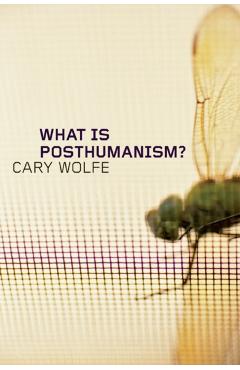
What Is Posthumanism? - Cary Wolfe
Cod EAN 9780816666157
Preț
161,92 lei
179,91 lei
−10%
Fără reducere reală
Cel mai mic preț din cele 9 zile dinainte de 22 octombrie 2026 a fost 143,93 lei, mai mic decât acum. Reducerea de −10% e calculată față de prețul vechi afișat de magazin (179,91 lei).
Peste prețul mediu din ultimele 25 de zile
Media: 160 lei. Cel mai mic preț a fost 143,93 lei, ultima dată pe 21 octombrie 2026; acum e cu 12% mai mult. Vezi istoricul
la Libris
- Transport gratuit peste 135 lei
- Cupon de 10% la abonarea la newsletter
- Retur extins la 30 de zile
În stoc la Libris Prețuri actualizate la 22 octombrie 2026, 16:11
Oferta disponibilă
Prețurile și disponibilitatea sunt preluate automat de la magazine și se pot schimba. Când cumperi printr-un link de pe site, putem primi un comision de la magazin, fără niciun cost în plus pentru tine. Cum funcționează
-
 What Is Posthumanism? - Cary Wolfe
În stoc
161,92 lei
Cel mai mic preț înainte
179,91 lei
Istoricul prețului
| Perioada | Cel mai mic | Cel mai mare | Prețul mediu | Scăderi |
|---|---|---|---|---|
| De când îl urmărim (25 de zile) | 143,93 lei | 161,92 lei | 160 lei | 1 |
Vezi schimbările de preț
| Din data | Cel mai mic preț |
|---|---|
| 22 octombrie 2026 | 161,92 lei |
| 20 octombrie 2026 | 143,93 lei |
| 13 octombrie 2026 | 161,92 lei |
Descriere
\nWhat does it mean to think beyond humanism? Is it possible to craft a mode of philosophy, ethics, and interpretation that rejects the classic humanist divisions of self and other, mind and body, society and nature, human and animal, organic and technological? Can a new kind of humanities-posthumanities-respond to the redefinition of humanity's place in the world by both the technological and the biological or green continuum in which the human is but one life form among many? Exploring how both critical thought along with cultural practice have reacted to this radical repositioning, Cary Wolfe-one of the founding figures in the field of animal studies and posthumanist theory-ranges across bioethics, cognitive science, animal ethics, gender, and disability to develop a theoretical and philosophical approach responsive to our changing understanding of ourselves and our world. Then, in performing posthumanist readings of such diverse works as Temple Grandin's writings, Wallace Stevens's poetry, Lars von Trier's Dancer in the Dark, the architecture of Diller+Scofidio, and David Byrne and Brian Eno's My Life in the Bush of Ghosts, he shows how this philosophical sensibility can transform art and culture. For Wolfe, a vibrant, rigorous posthumanism is vital for addressing questions of ethics and justice, language and trans-species communication, social systems and their inclusions and exclusions, and the intellectual aspirations of interdisciplinarity. In What Is Posthumanism? he carefully distinguishes posthumanism from transhumanism (the biotechnological enhancement of human beings) and narrow definitions of the posthuman as the hoped-for transcendence of materiality. In doing so, Wolfe reveals that it is humanism, not the human in all its embodied and prosthetic complexity, that is left behind in posthumanist thought. \nWhat does it mean to think beyond humanism? Is it possible to craft a mode of philosophy, ethics, and interpretation that rejects the classic humanist divisions of self and other, mind and body, society and nature, human and animal, organic and technological? Can a new kind of humanities-posthumanities-respond to the redefinition of humanity's place in the world by both the technological and the biological or green continuum in which the human is but one life form among many? Exploring how both critical thought along with cultural practice have reacted to this radical repositioning, Cary Wolfe-one of the founding figures in the field
Descrierea este preluată de la magazin.


