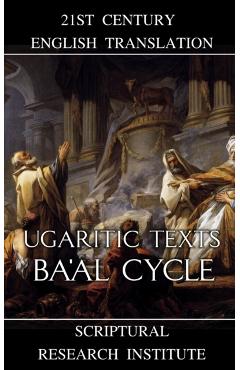
Ugaritic Texts: Ba'al Cycle - Scriptural Research Institute
Cod EAN 9781990289149
Preț
104,55 lei
116,17 lei
−10%
Fără reducere reală
Cel mai mic preț din cele 9 zile dinainte de 22 octombrie 2026 a fost 92,94 lei, mai mic decât acum. Reducerea de −10% e calculată față de prețul vechi afișat de magazin (116,17 lei).
Peste prețul mediu din ultimele 28 de zile
Media: 104 lei. Cel mai mic preț a fost 92,94 lei, ultima dată pe 21 octombrie 2026; acum e cu 12% mai mult. Vezi istoricul
la Libris
- Transport gratuit peste 135 lei
- Cupon de 10% la abonarea la newsletter
- Retur extins la 30 de zile
În stoc la Libris Prețuri actualizate la 22 octombrie 2026, 16:15
Oferta disponibilă
Prețurile și disponibilitatea sunt preluate automat de la magazine și se pot schimba. Când cumperi printr-un link de pe site, putem primi un comision de la magazin, fără niciun cost în plus pentru tine. Cum funcționează
-
 Ugaritic Texts: Ba'al Cycle - Scriptural Research Institute
În stoc
104,55 lei
Cel mai mic preț înainte
116,17 lei
Istoricul prețului
| Perioada | Cel mai mic | Cel mai mare | Prețul mediu | Scăderi |
|---|---|---|---|---|
| De când îl urmărim (28 de zile) | 92,94 lei | 104,55 lei | 104 lei | 1 |
Vezi schimbările de preț
| Din data | Cel mai mic preț |
|---|---|
| 22 octombrie 2026 | 104,55 lei |
| 20 octombrie 2026 | 92,94 lei |
| 13 octombrie 2026 | 104,55 lei |
Descriere
\nThe Ba'al Cycle, or Ba'al Saga, is a collection of stories about Ba'al Hadad, the supreme god of the Canaanite pantheon in the late bronze age. The Ugaritic Texts are ancient tablets that were recovered from archaeological digs at the ruins of Ugarit, a bronze-age city in northwest Syria, at the foot of the mountain Jebel Aqra on the modern Syrian-Turkish border.The Ba'al Cycle is generally divided into several sections, based on the groupings of the tablets that were discovered, however, this series of translations is divided into just two sections, Victorious Ba'al, and Ba'al Defeats Mot. These divisions are always subjective. Some translators divide the central section regarding the building of Ba'al's Temple on Mount Zaphon from the preceding battle with Yam. Others also separate out the intermediate section involving Ba'al's discussion with Anat, however, this series is divided based on the apparent shift in source material between the early section and the later section. The earliest section appears to be a translation from ancient Egyptian and includes Egyptian loanwords, as well as numerous references to the houses of the gods, which seems to be a reference to the system of decans used in Egypt from the Old Kingdom onward, to tell time at night.The main section of Ba'al Defeats Mot, appears to have been translated from an old Akkadian text that retold a Hurrian and Hattic story about two gods descending into the underworld. Many Akkadian, Hattic, and Hurrian loanwords are found in the later section, which are mostly missing from the earlier section, as well as the conclusion. The major exception being the messenger Ủgar, who was a Hurrian psychopomp, like the Canaanite Horon, and Greek Charon. As the city of Ugarit was named after him, this name clearly predates the text itself, and so it cannot be used to date the text. Nevertheless, does indicate that the city was originally a Hurrian settlement before becoming Semitic, which helps to explain why the older second section, appears to be a translation of an Akkadian retelling of a Hurrian story. Additionally, Luwian names are found in the second section, which places the origin of the Akkadian source text to sometime between when the Luwians settled in western Anatolia, generally dated to circa 2000 BC, and when the Hittites absorbed the Hattians around 1700 BC. As the text appears to have then been translated into Egyptian, before Ugaritic, it may trace the route the Hyksos took to Egypt
Descrierea este preluată de la magazin.