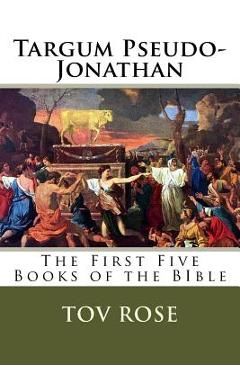
Targum Pseudo-Jonathan - Tov Rose
Cod EAN 9781523679942
Preț
61,96 lei
123,92 lei
−50%
Cel mai mic preț în ultimele 30 de zile: 61,96 lei
la Libris
- Transport gratuit peste 135 lei
- Cupon de 10% la abonarea la newsletter
- Retur extins la 30 de zile
În stoc la Libris Prețuri actualizate la 27 octombrie 2026, 18:26
Oferta disponibilă
Prețurile și disponibilitatea sunt preluate automat de la magazine și se pot schimba. Când cumperi printr-un link de pe site, putem primi un comision de la magazin, fără niciun cost în plus pentru tine. Cum funcționează
-
Targum Pseudo-Jonathan - Tov Rose
În stoc
61,96 leiCel mai mic preț înainte
123,92 lei
Istoricul prețului
Vezi schimbările de preț
| Din data | Cel mai mic preț |
|---|---|
| 27 octombrie 2026 | 61,96 lei |
| 13 octombrie 2026 | 123,92 lei |
Descriere
\nTargum Jonathan, otherwise referred to as Targum Yonasan/Yonatan, is the official eastern (Babylonian) targum to the Nevi'im. Its early origins, however, are western (i.e. from the Land of Israel), and the Talmudic tradition attributes its authorship to Jonathan ben Uzziel. Its overall style is very similar to that of Targum Onkelos, though at times it seems to be a looser paraphrase. The original language of Targum Jonathan is Aramaic. This edition is English. In Talmudic times (and to this day in Yemenite Jewish communities) Targum Jonathan was read as a verse-by-verse translation alternatively with the Hebrew verses of the haftarah in the synagogue. Thus, when the Talmud states that a person should complete his portions of scripture along with the community, reading the scripture twice and the targum once (Berakhot 8a-b), the passage may be taken to refer to Targum Jonathan (as well as to Targum Onkelos on the Torah). Targum Pseudo-Jonathan is a western targum (translation) of the Torah (Pentateuch) from the land of Israel (as opposed to the eastern Babylonian Targum Onkelos). Its correct title was originally Targum Yerushalmi (Jerusalem Targum), which is how it was known in medieval times. But because of a printer's mistake it was later labeled Targum Jonathan, in reference to Jonathan ben Uzziel. Some editions of the Pentateuch continue to call it Targum Jonathan to this day. Most scholars refer to the text as Targum Pseudo-Jonathan, or with the acronym TPsJ. The Talmud relates that Yonatan ben Uziel, a student of Hillel, fashioned an Aramaic translation of the Prophets (Megillah 3a). It makes no mention of any translation by him of the Torah. So all scholars agree that this Targum is not due to Yonatan ben Uziel. Indeed, de Rossi (16th century) reports that he saw two very similar complete Targumim to the Torah, one called Targum Yonatan Ben Uziel and the other called Targum Yerushalmi. A standard explanation is that the original title of this work was Targum Yerushalmi, which was abbreviated to (TY), and these initials were then incorrectly expanded to Targum Yonatan which was then further incorrectly expanded to Targum Yonatan ben Uziel. For these reasons, scholars call it Targum Pseudo-Jonathan. The first of these manuscripts cited by de Rossi is thought to have been the basis of the first printing in Venice (1591) where the false title Targum Yonatan ben Uziel is used. The second manuscript - the only known one to still exist - is in the
Descrierea este preluată de la magazin.