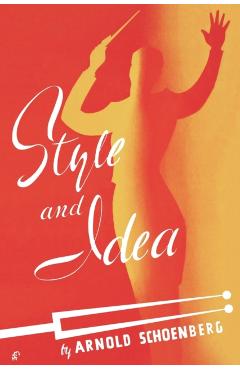
Style and Idea - Arnold Schoenberg
Cod EAN 9780806530956
Preț
89,28 lei
99,20 lei
−10%
Fără reducere reală
Cel mai mic preț din cele 9 zile dinainte de 22 octombrie 2026 a fost 79,36 lei, mai mic decât acum. Reducerea de −10% e calculată față de prețul vechi afișat de magazin (99,20 lei).
Peste prețul mediu din ultimele 27 de zile
Media: 88,55 lei. Cel mai mic preț a fost 79,36 lei, ultima dată pe 21 octombrie 2026; acum e cu 13% mai mult. Vezi istoricul
la Libris
- Transport gratuit peste 135 lei
- Cupon de 10% la abonarea la newsletter
- Retur extins la 30 de zile
În stoc la Libris Prețuri actualizate la 22 octombrie 2026, 16:15
Oferta disponibilă
Prețurile și disponibilitatea sunt preluate automat de la magazine și se pot schimba. Când cumperi printr-un link de pe site, putem primi un comision de la magazin, fără niciun cost în plus pentru tine. Cum funcționează
-
 Style and Idea - Arnold Schoenberg
În stoc
89,28 lei
Cel mai mic preț înainte
99,20 lei
Istoricul prețului
| Perioada | Cel mai mic | Cel mai mare | Prețul mediu | Scăderi |
|---|---|---|---|---|
| De când îl urmărim (27 de zile) | 79,36 lei | 89,28 lei | 88,55 lei | 1 |
Vezi schimbările de preț
| Din data | Cel mai mic preț |
|---|---|
| 22 octombrie 2026 | 89,28 lei |
| 20 octombrie 2026 | 79,36 lei |
| 13 octombrie 2026 | 89,28 lei |
Descriere
This book is full of essays which Arnold Schoenberg wrote on style and idea. He talks about the relationship to the text, new and outmoded music, composition in twelve tones, entertaining through composing, the relationship of heart and mind in music, evaluation of music, and other essays. Arnold Schoenberg (13 September 1874 - 13 July 1951) was an Austrian and later American composer, associated with the expressionist movement in German poetry and art, and leader of the Second Viennese School. He used the spelling Schönberg until after his move to the United States in 1934 (Steinberg 1995, 463), in deference to American practice (Foss 1951, 401), though one writer claims he made the change a year earlier (Ross 2007, 45). Schoenberg was known early in his career for successfully extending the traditionally opposed German Romantic traditions of both Brahms and Wagner, and later and more notably for his pioneering innovations in atonality. During the rise of the Nazi party in Austria, his music was labeled, alongside swing and jazz, as degenerate art. In the 1920s, he developed the twelve-tone technique, a widely influential compositional method of manipulating an ordered series of all twelve notes in the chromatic scale. He also coined the term developing variation, and was the first modern composer to embrace ways of developing motifs without resorting to the dominance of a centralized melodic idea. Schoenberg's approach, both in terms of harmony and development, is among the major landmarks of 20th century musical thought; at least three generations of composers in the European and American traditions have consciously extended his thinking and, in some cases, passionately reacted against it. Schoenberg was also a painter, an important music theorist, and an influential teacher of composition; his students included Alban Berg, Anton Webern, Hanns Eisler, and later John Cage, Lou Harrison, Earl Kim, Wayne Barlow, and many other prominent musicians. Many of Schoenberg's practices, including the formalization of compositional method, and his habit of openly inviting audiences to think analytically, are echoed in avant-garde musical thought throughout the 20th century. His often polemical views of music history and aesthetics were crucial to many of the 20th century's significant musicologists and critics, including Theodor Adorno, Charles Rosen, and Carl Dahlhaus. Schoenberg's archival legacy is collected at the Arnold Schönberg Center in Vienna.
Descrierea este preluată de la magazin.