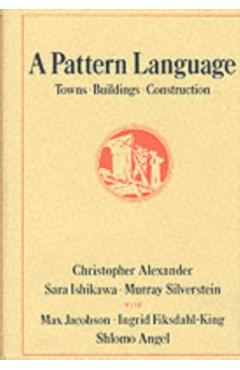
Pattern Language
Cod EAN 9780195019193
Preț
573,48 lei
637,20 lei
−10%
Fără reducere reală
Cel mai mic preț din cele 9 zile dinainte de 22 octombrie 2026 a fost 424,08 lei, mai mic decât acum. Reducerea de −10% e calculată față de prețul vechi afișat de magazin (637,20 lei).
Peste prețul mediu din ultimele 23 de zile
Media: 555 lei. Cel mai mic preț a fost 424,08 lei, ultima dată pe 19 octombrie 2026; acum e cu 35% mai mult. Vezi istoricul
la Libris
- Transport gratuit peste 135 lei
- Cupon de 10% la abonarea la newsletter
- Retur extins la 30 de zile
În stoc la Libris Prețuri actualizate la 22 octombrie 2026, 16:05
Oferta disponibilă
Prețurile și disponibilitatea sunt preluate automat de la magazine și se pot schimba. Când cumperi printr-un link de pe site, putem primi un comision de la magazin, fără niciun cost în plus pentru tine. Cum funcționează
-
 Pattern Language
În stoc
573,48 lei
Cel mai mic preț înainte
637,20 lei
Istoricul prețului
| Perioada | Cel mai mic | Cel mai mare | Prețul mediu | Scăderi |
|---|---|---|---|---|
| De când îl urmărim (23 de zile) | 424,08 lei | 573,48 lei | 555 lei | 1 |
Vezi schimbările de preț
| Din data | Cel mai mic preț |
|---|---|
| 22 octombrie 2026 | 573,48 lei |
| 20 octombrie 2026 | 509,76 lei |
| 18 octombrie 2026 | 424,08 lei |
| 13 octombrie 2026 | 573,48 lei |
Descriere
You can use this book to design a house for yourself with your family; you can use it to work with your neighbors to improve your town and neighborhood; you can use it to design an office, or a workshop, or a public building. And you can use it to guide you in the actual process of construction. After a ten-year silence, Christopher Alexander and his colleagues at the Center for Environmental Structure are now publishing a major statement in the form of three books which will, in their words, lay the basis for an entirely new approach to architecture, building and planning, which will we hope replace existing ideas and practices entirely. The three books are The Timeless Way of Building, The Oregon Experiment, and this book, A Pattern Language. \n \n At the core of these books is the idea that people should design for themselves their own houses, streets, and communities. This idea may be radical (it implies a radical transformation of the architectural profession) but it comes simply from the observation that most of the wonderful places of the world were not made by architects but by the people. \n \n At the core of the books, too, is the point that in designing their environments people always rely on certain languages, which, like the languages we speak, allow them to articulate and communicate an infinite variety of designs within a forma system which gives them coherence. This book provides a language of this kind. It will enable a person to make a design for almost any kind of building, or any part of the built environment. \n \n Patterns, the units of this language, are answers to design problems (How high should a window sill be? How many stories should a building have? How much space in a neighborhood should be devoted to grass and trees?). More than 250 of the patterns in this pattern language are given: each consists of a problem statement, a discussion of the problem with an illustration, and a solution. As the authors say in their introduction, many of the patterns are archetypal, so deeply rooted in the nature of things that it seemly likely that they will be a part of human nature, and human action, as much in five hundred years as they are today. \n
Descrierea este preluată de la magazin.