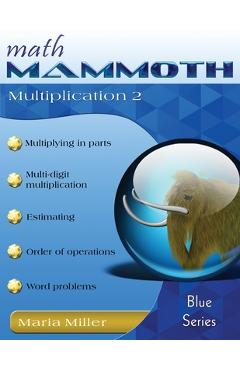
Math Mammoth Multiplication 2 - Maria Miller
Cod EAN 9781954358713
Preț
100,16 lei
111,29 lei
−10%
Fără reducere reală
Cel mai mic preț din cele 9 zile dinainte de 22 octombrie 2026 a fost 89,03 lei, mai mic decât acum. Reducerea de −10% e calculată față de prețul vechi afișat de magazin (111,29 lei).
Peste prețul mediu din ultimele 26 de zile
Media: 99,30 lei. Cel mai mic preț a fost 89,03 lei, ultima dată pe 21 octombrie 2026; acum e cu 13% mai mult. Vezi istoricul
la Libris
- Transport gratuit peste 135 lei
- Cupon de 10% la abonarea la newsletter
- Retur extins la 30 de zile
În stoc la Libris Prețuri actualizate la 22 octombrie 2026, 16:15
Oferta disponibilă
Prețurile și disponibilitatea sunt preluate automat de la magazine și se pot schimba. Când cumperi printr-un link de pe site, putem primi un comision de la magazin, fără niciun cost în plus pentru tine. Cum funcționează
-
 Math Mammoth Multiplication 2 - Maria Miller
În stoc
100,16 lei
Cel mai mic preț înainte
111,29 lei
Istoricul prețului
| Perioada | Cel mai mic | Cel mai mare | Prețul mediu | Scăderi |
|---|---|---|---|---|
| De când îl urmărim (26 de zile) | 89,03 lei | 100,16 lei | 99,30 lei | 1 |
Vezi schimbările de preț
| Din data | Cel mai mic preț |
|---|---|
| 22 octombrie 2026 | 100,16 lei |
| 20 octombrie 2026 | 89,03 lei |
| 13 octombrie 2026 | 100,16 lei |
Descriere
Math Mammoth Multiplication 2 is a worktext focusing on multi-digit multiplication and related topics. It best suits fourth grade mathematics. \n The first lessons briefly review the concept of multiplication and the multiplication tables. Next, students encounter equations in disguise - presented with shapes on both sides of a pan balance - in the lesson Scales Puzzles. This lesson is intended to be fun and motivational. \n Then, the focus shifts to multi-digit multiplication (also called multiplication algorithm or multiplying in columns). We start out by learning to multiply numbers by multiples of ten and hundred (for example, 20 × 4 or 500 × 6). After this is mastered, students learn the very important concept of multiplying in parts, or partial products. This means that, for example, we multiply 4 × 63 in two parts: first we multiply 4 × 60 = 240 and 4 × 3 = 12, and lastly the results are added: 240 + 12 = 252. \n This principle underlies all other multiplication algorithms, so it is important to master. We don't want children to blindly memorize the multiplication algorithm without understanding what is going on with it. The partial products algorithm (multiplying in parts) also ties in with an area model, and it is very important that students see the connection between this visual model and the procedure. \n The book contains two lessons about multiplying in columns the easy way. This easy way is a simplified form of the traditional multiplication algorithm, based on partial products. You may skip these two lessons at your discretion. The method taught in those lessons is most useful for students who may have trouble with the traditional form of the algorithm. This method is also helpful in cementing the student's understanding of the partial products method. \n The traditional, or standard, form of multiplication algorithm is taught next, and is hopefully fairly easy, with the partial products as a foundation. \n Students also study estimation, the order of operations, and multiplying with money. There are numerous word problems in all of the lessons. Students are encouraged to write number sentences for the word problems-essentially learning to show their work and their thinking process. \n The lesson So Many of the Same Thing has to do with proportional reasoning. The idea is really simple, and prepares students for learning ratios and proportions in middle school. \n The last major topic in the book is multiplying two-dig
Descrierea este preluată de la magazin.