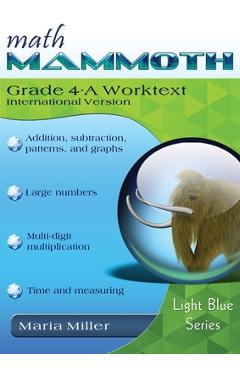
Math Mammoth Grade 6-B Worktext - Maria Miller
Cod EAN 9781954358072
Preț
157,63 lei
175,15 lei
−10%
Fără reducere reală
Cel mai mic preț din cele 9 zile dinainte de 22 octombrie 2026 a fost 140,12 lei, mai mic decât acum. Reducerea de −10% e calculată față de prețul vechi afișat de magazin (175,15 lei).
Peste prețul mediu din ultimele 27 de zile
Media: 156 lei. Cel mai mic preț a fost 140,12 lei, ultima dată pe 21 octombrie 2026; acum e cu 12% mai mult. Vezi istoricul
la Libris
- Transport gratuit peste 135 lei
- Cupon de 10% la abonarea la newsletter
- Retur extins la 30 de zile
În stoc la Libris Prețuri actualizate la 22 octombrie 2026, 16:05
Oferta disponibilă
Prețurile și disponibilitatea sunt preluate automat de la magazine și se pot schimba. Când cumperi printr-un link de pe site, putem primi un comision de la magazin, fără niciun cost în plus pentru tine. Cum funcționează
-
 Math Mammoth Grade 6-B Worktext - Maria Miller
În stoc
157,63 lei
Cel mai mic preț înainte
175,15 lei
Istoricul prețului
| Perioada | Cel mai mic | Cel mai mare | Prețul mediu | Scăderi |
|---|---|---|---|---|
| De când îl urmărim (27 de zile) | 140,12 lei | 157,63 lei | 156 lei | 1 |
Vezi schimbările de preț
| Din data | Cel mai mic preț |
|---|---|
| 22 octombrie 2026 | 157,63 lei |
| 20 octombrie 2026 | 140,12 lei |
| 13 octombrie 2026 | 157,63 lei |
Descriere
\nMath Mammoth Grade 6-B Worktext is the second student book in Math Mammoth grade 6 curriculum, meant for the latter half of 6th grade. This is the 2022 edition. \nThe main areas of study in Math Mammoth Grade 6-B worktext are: prime factorization, GCF, and LCMfraction arithmetic with a focus on division of fractionsthe concept of integers, coordinate grid, addition & subtraction of integersgeometry: review of quadrilaterals & drawing problems; area of triangles & polygons; volume of rectangular prisms with fractional edge lengths; surface areastatistics: concept of distribution, measures of center, measures of variation, boxplots, stem-and-leaf plots, histograms \nChapter 6 first reviews prime factorization and then teaches students two new concepts: the greatest common factor and the least common multiple. We also apply those concepts factor to simplify fractions and to find common denominators for adding fractions. \nIn Chapter 7, students first review addition, subtraction, and multiplication of fractions from fifth grade. Then we focus on a new topic: the division of fractions. The chapter also includes ample practice in solving problems with fractions. \nChapter 8 introduces students to integers (signed numbers). They plot points in all four quadrants of the coordinate plane, reflect and translate simple figures, and learn to add and subtract with negative numbers. (Multiplication and division of integers will be studied in 7th grade.) \nThe next chapter, Geometry, focuses on calculating the area of polygons. After a brief review of terminology for triangles and quadrilaterals and drawing fundamentals, this new topic is presented simply in a logical progression: first, the area of a right triangle; next, the area of a parallelogram; then, the area of any triangle; and finally, the area of a polygon. After that, students learn how to use nets of simple solids to calculate their surface area. Lastly, we turn to the concept of volume. Students have already learned to find the volumes of rectangular prisms in 5th grade. Now they calculate the volumes of rectangular prisms with fractional edge lengths. \nThe final chapter is about statistics. Beginning with the concept of a statistical distribution, students learn about measures of center and measures of variability. They also learn how to make dot plots, histograms, boxplots, and stem-and-leaf plots as ways to summarize and analyze distributions. \nFeaturesMath Mammoth focuses on conceptual und
Descrierea este preluată de la magazin.