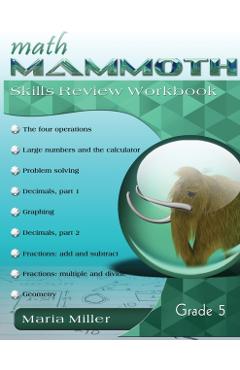
Math Mammoth Fractions 2 - Maria Miller
Cod EAN 9781954358607
Preț
97,37 lei
108,19 lei
−10%
Fără reducere reală
Cel mai mic preț din cele 9 zile dinainte de 22 octombrie 2026 a fost 86,55 lei, mai mic decât acum. Reducerea de −10% e calculată față de prețul vechi afișat de magazin (108,19 lei).
Peste prețul mediu din ultimele 29 de zile
Media: 96,62 lei. Cel mai mic preț a fost 86,55 lei, ultima dată pe 21 octombrie 2026; acum e cu 13% mai mult. Vezi istoricul
la Libris
- Transport gratuit peste 135 lei
- Cupon de 10% la abonarea la newsletter
- Retur extins la 30 de zile
În stoc la Libris Prețuri actualizate la 22 octombrie 2026, 16:15
Oferta disponibilă
Prețurile și disponibilitatea sunt preluate automat de la magazine și se pot schimba. Când cumperi printr-un link de pe site, putem primi un comision de la magazin, fără niciun cost în plus pentru tine. Cum funcționează
-
 Math Mammoth Fractions 2 - Maria Miller
În stoc
97,37 lei
Cel mai mic preț înainte
108,19 lei
Istoricul prețului
| Perioada | Cel mai mic | Cel mai mare | Prețul mediu | Scăderi |
|---|---|---|---|---|
| De când îl urmărim (29 de zile) | 86,55 lei | 97,37 lei | 96,62 lei | 1 |
Vezi schimbările de preț
| Din data | Cel mai mic preț |
|---|---|
| 22 octombrie 2026 | 97,37 lei |
| 20 octombrie 2026 | 86,55 lei |
| 13 octombrie 2026 | 97,37 lei |
Descriere
Math Mammoth Fractions 2 continues the study of fraction topics after Math Mammoth Fractions 1. (I sincerely recommend that the student study the Fractions 1 book prior to studying this book, if he has not already done so.) \n This book is meant for fifth grade, and deals in-depth with the following topics: \n simplifying; including simplifying before multiplying multiplication of fractions (and of mixed numbers) division of fractions \n We start out by simplifying fractions. Since this process is the opposite of making equivalent fractions, studied in Math Mammoth Fractions 1, it should be relatively simple for students to understand. We also use the same visual model, just backwards: This time the pie pieces are joined together instead of split apart. \n Next comes multiplying a fraction by a whole number. Since this can be solved by repeated addition, it is not a difficult concept at all. \n Multiplying a fraction by a fraction is first explained as taking a certain part of a fraction, in order to teach the concept. After that, students are shown the usual shortcut for the multiplication of fractions. \n Then, we find the area of a rectangle with fractional side lengths, and show that the area is the same as it would be found by multiplying the side lengths. Students multiply fractional side lengths to find areas of rectangles, and represent fraction products as rectangular areas. \n Simplifying before multiplying is a process that is not absolutely necessary for fifth graders. I have included it here because it prepares students for the same process in future algebra studies and because it makes fraction multiplication easier. \n Students also multiply mixed numbers, and study how multiplication can be seen as resizing or scaling. This means, for example, that the multiplication (2/3) × 18 km can be thought of as finding two-thirds of 18 km. \n Next, we study the division of fractions. The first lesson on the topic shows how fractions can be seen as divisions; in other words, for example, 5/3 is the same as 5 3. This of course gives us a means of dividing whole numbers and getting fractional answers (for example, 20 6 = 3 2/6). \n The next lesson on the topic explores the thought of solving division problems by multiplying, and then introduces reciprocal numbers and the common shortcut for fraction division. \n The following two lessons focus on two ways to think about division: equal sharing, and fitting the divisor (measurement
Descrierea este preluată de la magazin.