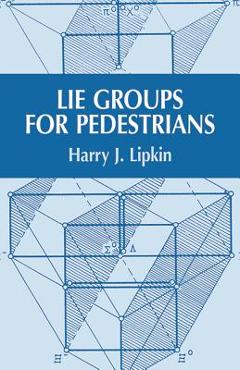
Lie Groups for Pedestrians - Harry J. Lipkin
Cod EAN 9780486421858
Preț
72,26 lei
80,29 lei
−10%
Fără reducere reală
Cel mai mic preț din cele 9 zile dinainte de 22 octombrie 2026 a fost 64,23 lei, mai mic decât acum. Reducerea de −10% e calculată față de prețul vechi afișat de magazin (80,29 lei).
Peste prețul mediu din ultimele 30 de zile
Media: 71,72 lei. Cel mai mic preț a fost 64,23 lei, ultima dată pe 21 octombrie 2026; acum e cu 13% mai mult. Vezi istoricul
la Libris
- Transport gratuit peste 135 lei
- Cupon de 10% la abonarea la newsletter
- Retur extins la 30 de zile
În stoc la Libris Prețuri actualizate la 7 noiembrie 2026, 23:40
Oferta disponibilă
Prețurile și disponibilitatea sunt preluate automat de la magazine și se pot schimba. Când cumperi printr-un link de pe site, putem primi un comision de la magazin, fără niciun cost în plus pentru tine. Cum funcționează
-
 Lie Groups for Pedestrians - Harry J. Lipkin
În stoc
72,26 lei
Cel mai mic preț înainte
80,29 lei
Istoricul prețului
| Perioada | Cel mai mic | Cel mai mare | Prețul mediu | Scăderi |
|---|---|---|---|---|
| Ultimele 30 de zile | 64,23 lei | 72,26 lei | 71,72 lei | 1 |
Vezi schimbările de preț
| Din data | Cel mai mic preț |
|---|---|
| 22 octombrie 2026 | 72,26 lei |
| 20 octombrie 2026 | 64,23 lei |
| 13 octombrie 2026 | 72,26 lei |
Descriere
\n \nAccording to the author of this concise, high-level study, physicists often shy away from group theory, perhaps because they are unsure which parts of the subject belong to the physicist and which belong to the mathematician. However, it is possible for physicists to understand and use many techniques which have a group theoretical basis without necessarily understanding all of group theory. This book is designed to familiarize physicists with those techniques. Specifically, the author aims to show how the well-known methods of angular momentum algebra can be extended to treat other Lie groups, with examples illustrating the application of the method. \nChapters cover such topics as a simple example of isospin; the group SU3 and its application to elementary particles; the three-dimensional harmonic oscillator; algebras of operators which change the number of particles; permutations; bookkeeping and Young diagrams; and the groups SU4, SU6, and SU12, an introduction to groups of higher rank. Four appendices provide additional valuable data.\n
Descrierea este preluată de la magazin.