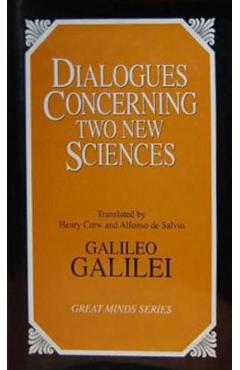
Dialogues Concerning Two New Sciences - Galileo Galilei
Cod EAN 9781573920810
Preț
141,27 lei
156,97 lei
−10%
Fără reducere reală
Cel mai mic preț din cele 9 zile dinainte de 22 octombrie 2026 a fost 125,58 lei, mai mic decât acum. Reducerea de −10% e calculată față de prețul vechi afișat de magazin (156,97 lei).
Peste prețul mediu din ultimele 28 de zile
Media: 140 lei. Cel mai mic preț a fost 125,58 lei, ultima dată pe 21 octombrie 2026; acum e cu 12% mai mult. Vezi istoricul
la Libris
- Transport gratuit peste 135 lei
- Cupon de 10% la abonarea la newsletter
- Retur extins la 30 de zile
În stoc la Libris Prețuri actualizate la 22 octombrie 2026, 16:15
Oferta disponibilă
Prețurile și disponibilitatea sunt preluate automat de la magazine și se pot schimba. Când cumperi printr-un link de pe site, putem primi un comision de la magazin, fără niciun cost în plus pentru tine. Cum funcționează
-
 Dialogues Concerning Two New Sciences - Galileo Galilei
În stoc
141,27 lei
Cel mai mic preț înainte
156,97 lei
Istoricul prețului
| Perioada | Cel mai mic | Cel mai mare | Prețul mediu | Scăderi |
|---|---|---|---|---|
| De când îl urmărim (28 de zile) | 125,58 lei | 141,27 lei | 140 lei | 1 |
Vezi schimbările de preț
| Din data | Cel mai mic preț |
|---|---|
| 22 octombrie 2026 | 141,27 lei |
| 20 octombrie 2026 | 125,58 lei |
| 13 octombrie 2026 | 141,27 lei |
Descriere
GALILEO GALILEI was born in Pisa on February 15, 1564, into a family of impoverished nobility. In 1581 he enrolled at the University of Pisa to study medicine, but later abandoned this for mathematics. Galileo was appointed chair of mathematics at Pisa, and remained in that post until 1591; later he moved to Padua, and finally to Florence. \n In marked contrast with the established tradition of science, Galileo relied on experimentation rather than ab-stract theorizing about the operation of the physical uni-verse. The famous experiment conducted from the top of the leaning tower of Pisa demolished the Aristotelian dictum that objects fall with a velocity equal to their weight. Galileo's avowal of the Copernican theory of the solar system, which set the sun and not the earth at the center, put him at loggerheads with ecclesiastical authority. Galileo was denounced publicly by the clergy and his peers; following the publication of his Dialogue Concerning Two Chief World Systems in 1632, Galileo was brought before the Inquisition for heresy and ordered to recant. The Inquisition subsequently decreed that all copies of the Dialogue be burned and that Galileo be imprisoned for the remainder of his life. The sentence was later commuted to house arrest at Arcetri, outside Florence. \n \n Despite its suppression in Italy, the Dialogue Con-cerning Two Chief World Systems was translated and disseminated throughout Europe. Galileo likewise became known for his discoveries of new heavenly bodies and refinements of the telescope. His last work, Dialogues Con-cerning Two New Sciences (1638), completed while under house arrest and smuggled out of Italy, deals with the motion and resistance of bodies. Galileo regarded the Two New Sciences as the best of all his studies. Indeed this work, the result of more than thirty years' experimentation and labor, may stand as the greatest monument to a life devoted to scientific truth and defiant of all strictures on freedom of expression. Galileo died at his villa in Arcetri on January 8, 1642; coincidentally, the year of his death is the year Sir Isaac Newton was born. \n \nGalileo Galilei's other published works include Sidereus Nuncius (Starry Messenger) (1610), on the revolution of heavenly bodies; and Letters on Sunspots (1613).\n
Descrierea este preluată de la magazin.