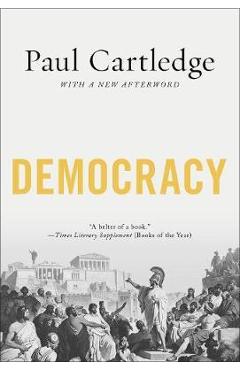
Democracy: A Life - Paul Cartledge
Cod EAN 9780190866273
Preț
139,45 lei
154,94 lei
−10%
Fără reducere reală
Cel mai mic preț din cele 9 zile dinainte de 22 octombrie 2026 a fost 123,95 lei, mai mic decât acum. Reducerea de −10% e calculată față de prețul vechi afișat de magazin (154,94 lei).
Peste prețul mediu din ultimele 29 de zile
Media: 138 lei. Cel mai mic preț a fost 123,95 lei, ultima dată pe 21 octombrie 2026; acum e cu 13% mai mult. Vezi istoricul
la Libris
- Transport gratuit peste 135 lei
- Cupon de 10% la abonarea la newsletter
- Retur extins la 30 de zile
În stoc la Libris Prețuri actualizate la 22 octombrie 2026, 16:15
Oferta disponibilă
Prețurile și disponibilitatea sunt preluate automat de la magazine și se pot schimba. Când cumperi printr-un link de pe site, putem primi un comision de la magazin, fără niciun cost în plus pentru tine. Cum funcționează
-
 Democracy: A Life - Paul Cartledge
În stoc
139,45 lei
Cel mai mic preț înainte
154,94 lei
Istoricul prețului
| Perioada | Cel mai mic | Cel mai mare | Prețul mediu | Scăderi |
|---|---|---|---|---|
| De când îl urmărim (29 de zile) | 123,95 lei | 139,45 lei | 138 lei | 1 |
Vezi schimbările de preț
| Din data | Cel mai mic preț |
|---|---|
| 22 octombrie 2026 | 139,45 lei |
| 20 octombrie 2026 | 123,95 lei |
| 13 octombrie 2026 | 139,45 lei |
Descriere
\nAncient Greece first coined the concept of democracy, yet almost every major ancient Greek thinker-from Plato and Aristotle onwards- was ambivalent towards or even hostile to democracy in any form. The explanation for this is quite simple: the elite perceived majority power as tantamount to a dictatorship of the proletariat. In ancient Greece there can be traced not only the rudiments of modern democratic society but the entire Western tradition of anti-democratic thought. In Democracy, Paul Cartledge provides a detailed history of this ancient political system. In addition, by drawing out the salient differences between ancient and modern forms of democracy he enables a richer understanding of both. Cartledge contends that there is no one ancient Greek democracy as pure and simple as is often believed. Democracy surveys the emergence and development of Greek politics, the invention of political theory, and-intimately connected to the latter- the birth of democracy, first at Athens in c. 500 BCE and then at its greatest flourishing in the Greek world 150 years later. Cartledge then traces the decline of genuinely democratic Greek institutions at the hands of the Macedonians and-subsequently and decisively-the Romans. Throughout, he sheds light on the variety of democratic practices in the classical world as well as on their similarities to and dissimilarities from modern democratic forms, from the American and French revolutions to contemporary political thought. Authoritative and accessible, Cartledge's book will be regarded as the best account of ancient democracy and its long afterlife for many years to come. \n \nAncient Greece first coined the concept of democracy, yet almost every major ancient Greek thinker-from Plato and Aristotle onwards- was ambivalent towards or even hostile to democracy in any form. The explanation for this is quite simple: the elite perceived majority power as tantamount to a dictatorship of the proletariat. In ancient Greece there can be traced not only the rudiments of modern democratic society but the entire Western tradition of anti-democratic thought. In Democracy, Paul Cartledge provides a detailed history of this ancient political system. In addition, by drawing out the salient differences between ancient and modern forms of democracy he enables a richer understanding of both. Cartledge contends that there is no one ancient Greek democracy as pure and simple as is often believed. Democracy surveys the emergenc
Descrierea este preluată de la magazin.