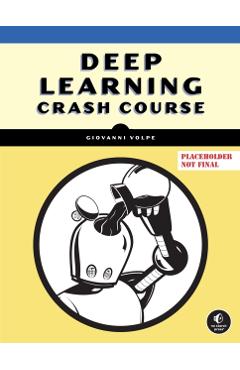
Deep Learning Crash Course - Giovanni Volpe
Cod EAN 9781718503922
Preț
349,86 lei
388,73 lei
−10%
Fără reducere reală
Cel mai mic preț din cele 9 zile dinainte de 22 octombrie 2026 a fost 310,98 lei, mai mic decât acum. Reducerea de −10% e calculată față de prețul vechi afișat de magazin (388,73 lei).
Peste prețul mediu din ultimele 25 de zile
Media: 347 lei. Cel mai mic preț a fost 310,98 lei, ultima dată pe 21 octombrie 2026; acum e cu 13% mai mult. Vezi istoricul
la Libris
- Transport gratuit peste 135 lei
- Cupon de 10% la abonarea la newsletter
- Retur extins la 30 de zile
În stoc la Libris Prețuri actualizate la 22 octombrie 2026, 16:05
Oferta disponibilă
Prețurile și disponibilitatea sunt preluate automat de la magazine și se pot schimba. Când cumperi printr-un link de pe site, putem primi un comision de la magazin, fără niciun cost în plus pentru tine. Cum funcționează
-
 Deep Learning Crash Course - Giovanni Volpe
În stoc
349,86 lei
Cel mai mic preț înainte
388,73 lei
Istoricul prețului
| Perioada | Cel mai mic | Cel mai mare | Prețul mediu | Scăderi |
|---|---|---|---|---|
| De când îl urmărim (25 de zile) | 310,98 lei | 349,86 lei | 347 lei | 1 |
Vezi schimbările de preț
| Din data | Cel mai mic preț |
|---|---|
| 22 octombrie 2026 | 349,86 lei |
| 20 octombrie 2026 | 310,98 lei |
| 13 octombrie 2026 | 349,86 lei |
Descriere
Giovanni Volpe is a professor in the Physics Department of the University of Gothenburg, Sweden, and head of the Soft Matter Lab. His research interests include deep learning, brain connectivity, statistical mechanics, and soft matter. He has authored more than 200 articles and reviews on these topics and has co-authored two books. He has also developed several software packages for microscopy, deep learning, and brain connectivity. Joana B. Pereira is an associate professor at Karolinska Institute in Sweden, where she focuses on investigating new biomarkers for neurodegenerative disorders, in particular Alzheimer's disease. Since 2020, she has organized an annual interdisciplinary conference called Emerging Topics in Artificial Intelligence in San Diego, CA. She is the scientific coordinator for NeurotechEU and winner of the 2021 de Leon Prize for best neuroimaging article in Alzheimer's disease. Carlo Manzo is an associate professor at the University of Vic, Spain, where he leads the Quantitative Bioimaging Lab. His research is dedicated to the analysis of biophysical processes, merging deep learning techniques with state-of-the-art imaging technologies to achieve single-molecule sensitivity. He is the founder of the Anomalous Diffusion challenge and winner of the 2017 E. Pérez Payá Prize from the Sociedad de Biofísica de España. Benjamin Midtvedt is a doctoral researcher working to enhance the field of microscopy through deep learning. The unifying focus of his research has been the development of accessible and practical AI optimized to the needs of the user. He has also been the lead developer of several Python-based open-source deep learning frameworks. Jesús Pineda is a doctoral researcher in physics focused on the intersection between \ndeep learning and computer vision. He has co-authored several articles in high-impact journals on the application of deep learning to glean insights from microscopy data. Jesús is also a core developer of the deep learning software packages DeepTrack and Deeplay. Henrik Klein Moberg is a Ph.D. candidate at Chalmers University of Technology specializing in the integration of AI with physical sciences. His research focuses on applying deep learning techniques to nanofluidic microscopy and nanophotonics, aiming to enhance the precision and efficiency of these technologies. He has also organized and spoken at numerous conferences related to AI and scientific data analysis. Harshith Bachimanchi is a PhD student whose research combines holographic microscopy and deep learning to better understand marine microorganisms. Harshith has used deep learning techniques and experimental optics to track both biological and synthetic particles, enhancing our understanding of these complex systems. He has also developed simulations demonstrating the applications of deep learning in microscopy.
Descrierea este preluată de la magazin.