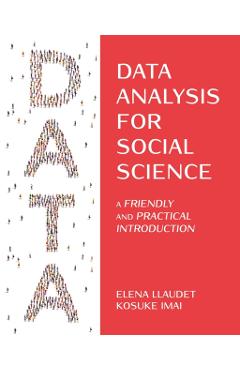
Data Analysis for Social Science: A Friendly and Practical Introduction - Elena Llaudet
Cod EAN 9780691199436
Preț
441,31 lei
490,34 lei
−10%
Fără reducere reală
Cel mai mic preț din cele 9 zile dinainte de 22 octombrie 2026 a fost 392,27 lei, mai mic decât acum. Reducerea de −10% e calculată față de prețul vechi afișat de magazin (490,34 lei).
Peste prețul mediu din ultimele 29 de zile
Media: 438 lei. Cel mai mic preț a fost 392,27 lei, ultima dată pe 21 octombrie 2026; acum e cu 13% mai mult. Vezi istoricul
la Libris
- Transport gratuit peste 135 lei
- Cupon de 10% la abonarea la newsletter
- Retur extins la 30 de zile
În stoc la Libris Prețuri actualizate la 22 octombrie 2026, 16:05
Oferta disponibilă
Prețurile și disponibilitatea sunt preluate automat de la magazine și se pot schimba. Când cumperi printr-un link de pe site, putem primi un comision de la magazin, fără niciun cost în plus pentru tine. Cum funcționează
-
 Data Analysis for Social Science: A Friendly and Practical Introduction - Elena Llaudet
În stoc
441,31 lei
Cel mai mic preț înainte
490,34 lei
Istoricul prețului
| Perioada | Cel mai mic | Cel mai mare | Prețul mediu | Scăderi |
|---|---|---|---|---|
| De când îl urmărim (29 de zile) | 392,27 lei | 441,31 lei | 438 lei | 1 |
Vezi schimbările de preț
| Din data | Cel mai mic preț |
|---|---|
| 22 octombrie 2026 | 441,31 lei |
| 20 octombrie 2026 | 392,27 lei |
| 13 octombrie 2026 | 441,31 lei |
Descriere
\n \nAn ideal textbook for an introductory course on quantitative methods for social scientists--assumes no prior knowledge of statistics or coding \n \nData Analysis for Social Science provides a friendly introduction to the statistical concepts and programming skills needed to conduct and evaluate social scientific studies. Using plain language and assuming no prior knowledge of statistics and coding, the book provides a step-by-step guide to analyzing real-world data with the statistical program R for the purpose of answering a wide range of substantive social science questions. It teaches not only how to perform the analyses but also how to interpret results and identify strengths and limitations. This one-of-a-kind textbook includes supplemental materials to accommodate students with minimal knowledge of math and clearly identifies sections with more advanced material so that readers can skip them if they so choose. \n\n \n- Analyzes real-world data using the powerful, open-sourced statistical program R, which is free for everyone to use \n- Teaches how to measure, predict, and explain quantities of interest based on data \n- Shows how to infer population characteristics using survey research, predict outcomes using linear models, and estimate causal effects with and without randomized experiments \n- Assumes no prior knowledge of statistics or coding \n- Specifically designed to accommodate students with a variety of math backgrounds \n- Provides cheatsheets of statistical concepts and R code \n- Supporting materials available online, including real-world datasets and the code to analyze them, plus--for instructor use--sample syllabi, sample lecture slides, additional datasets, and additional exercises with solutions \nLooking for a more advanced introduction? Consider Quantitative Social Science by Kosuke Imai. In addition to covering the material in Data Analysis for Social Science, it teaches diffs-in-diffs models, heterogeneous effects, text analysis, and regression discontinuity designs, among other things.\n
Descrierea este preluată de la magazin.