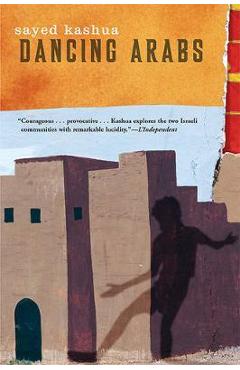
Dancing Arabs - Sayed Kashua
Cod EAN 9780802141262
Preț
106,02 lei
117,80 lei
−10%
Fără reducere reală
Cel mai mic preț din cele 11 zile dinainte de 25 octombrie 2026 a fost 94,24 lei, mai mic decât acum. Reducerea de −10% e calculată față de prețul vechi afișat de magazin (117,80 lei).
Peste prețul mediu din ultimele 25 de zile
Media: 104 lei. Cel mai mic preț a fost 94,24 lei, ultima dată pe 24 octombrie 2026; acum e cu 13% mai mult. Vezi istoricul
la Libris
- Transport gratuit peste 135 lei
- Cupon de 10% la abonarea la newsletter
- Retur extins la 30 de zile
În stoc la Libris Prețuri actualizate la 3 noiembrie 2026, 21:34
Oferta disponibilă
Prețurile și disponibilitatea sunt preluate automat de la magazine și se pot schimba. Când cumperi printr-un link de pe site, putem primi un comision de la magazin, fără niciun cost în plus pentru tine. Cum funcționează
-
 Dancing Arabs - Sayed Kashua
În stoc
106,02 lei
Cel mai mic preț înainte
117,80 lei
Istoricul prețului
| Perioada | Cel mai mic | Cel mai mare | Prețul mediu | Scăderi |
|---|---|---|---|---|
| De când îl urmărim (25 de zile) | 94,24 lei | 106,02 lei | 104 lei | 1 |
Vezi schimbările de preț
| Din data | Cel mai mic preț |
|---|---|
| 25 octombrie 2026 | 106,02 lei |
| 20 octombrie 2026 | 94,24 lei |
| 14 octombrie 2026 | 106,02 lei |
Descriere
The debut novel by 28-year-old Arab-Israeli Kashua has been praised around the world for its honesty, irony, humor, and its uniquely human portrayal of a young man who moves between two societies, becoming a stranger to both. \nA bildüngsroman suffused with humor and irony, Dancing Arabs centers on a young boy from a poor Arab village, his haphazard receipt of a scholarship to a Jewish boarding school, and the dislocation and alienation that ensues when he finds himself faced with the impossible: the imperative to straddle two famously incompatible worlds. As a child, our nameless narrator/antihero lives with his family in his grandmother's house. His grandmother and father constantly impress upon him the significance of their land: when so many people fled or sold theirs away, they held strong. Better to die fighting for your land than to give it away. \nEvery night after his brothers fall asleep, he climbs into bed with his grandmother, his main source of comfort and protection. One night she tells him where the key to her secret cupboard are, and if she should die, he must find all the death equipment in the blue bag. Paranoid from then on, he races home every day at recess to see if she's died. One day he gets there and she is not there, so he unlocks the cupboard and pulls out the box. All he finds are towels and some soaps from Mecca, but then he notices his father's photo in the old newspaper lining the suitcase, and some postcards in his father's handwriting. At his urging, his grandmother tells him about the newspaper clippings: his father was always the handsomest and the smartest in Tira, until he was thrown in jail for his political activity (eg: bombing a school cafeteria). The grandmother visited her son every week, wrote letters to the mayor, anyone who might be able to help her son. When he was released years later, he remained politically active, revering the Egyptian president Nasser, and for a time, joined the communist party. The young narrator is nothing like his father, who doesn't understand how my brothers and I came out the way we did. We can't even draw a flag. He says kids smaller than us walk through the streets singing 'P-L-O----Israel NO!' and he shouts at us for not even knowing what PLO stands for. Not at all politically motivated, the boy knows nothing of national identity; he simply wants to get through the school day without getting smacked by his teacher. He excels at school and his family dreams that by the time he gr
Descrierea este preluată de la magazin.