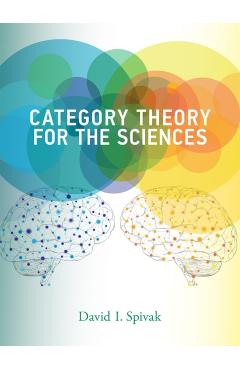
Category Theory for the Sciences - David I. Spivak
Cod EAN 9780262028134
Preț
455,33 lei
505,92 lei
−10%
Fără reducere reală
Cel mai mic preț din cele 9 zile dinainte de 22 octombrie 2026 a fost 404,74 lei, mai mic decât acum. Reducerea de −10% e calculată față de prețul vechi afișat de magazin (505,92 lei).
Peste prețul mediu din ultimele 28 de zile
Media: 452 lei. Cel mai mic preț a fost 404,74 lei, ultima dată pe 21 octombrie 2026; acum e cu 12% mai mult. Vezi istoricul
la Libris
- Transport gratuit peste 135 lei
- Cupon de 10% la abonarea la newsletter
- Retur extins la 30 de zile
În stoc la Libris Prețuri actualizate la 22 octombrie 2026, 16:15
Oferta disponibilă
Prețurile și disponibilitatea sunt preluate automat de la magazine și se pot schimba. Când cumperi printr-un link de pe site, putem primi un comision de la magazin, fără niciun cost în plus pentru tine. Cum funcționează
-
 Category Theory for the Sciences - David I. Spivak
În stoc
455,33 lei
Cel mai mic preț înainte
505,92 lei
Istoricul prețului
| Perioada | Cel mai mic | Cel mai mare | Prețul mediu | Scăderi |
|---|---|---|---|---|
| De când îl urmărim (28 de zile) | 404,74 lei | 455,33 lei | 452 lei | 1 |
Vezi schimbările de preț
| Din data | Cel mai mic preț |
|---|---|
| 22 octombrie 2026 | 455,33 lei |
| 20 octombrie 2026 | 404,74 lei |
| 13 octombrie 2026 | 455,33 lei |
Descriere
\n \nAn introduction to category theory as a rigorous, flexible, and coherent modeling language that can be used across the sciences.\n \nCategory theory was invented in the 1940s to unify and synthesize different areas in mathematics, and it has proven remarkably successful in enabling powerful communication between disparate fields and subfields within mathematics. This book shows that category theory can be useful outside of mathematics as a rigorous, flexible, and coherent modeling language throughout the sciences. Information is inherently dynamic; the same ideas can be organized and reorganized in countless ways, and the ability to translate between such organizational structures is becoming increasingly important in the sciences. Category theory offers a unifying framework for information modeling that can facilitate the translation of knowledge between disciplines.\n \nWritten in an engaging and straightforward style, and assuming little background in mathematics, the book is rigorous but accessible to non-mathematicians. Using databases as an entry to category theory, it begins with sets and functions, then introduces the reader to notions that are fundamental in mathematics: monoids, groups, orders, and graphs--categories in disguise. After explaining the big three concepts of category theory--categories, functors, and natural transformations--the book covers other topics, including limits, colimits, functor categories, sheaves, monads, and operads. The book explains category theory by examples and exercises rather than focusing on theorems and proofs. It includes more than 300 exercises, with solutions.\n \nCategory Theory for the Sciences is intended to create a bridge between the vast array of mathematical concepts used by mathematicians and the models and frameworks of such scientific disciplines as computation, neuroscience, and physics.\n
Descrierea este preluată de la magazin.