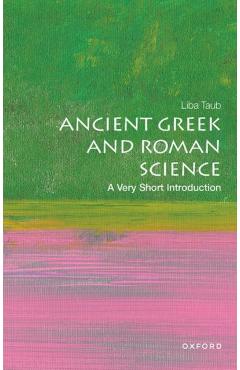
Ancient Science - Taub
Cod EAN 9780198736998
Preț
64,74 lei
71,93 lei
−10%
Fără reducere reală
Prețul e același de cel puțin 24 de zile. Reducerea de −10% e calculată față de prețul vechi afișat de magazin (71,93 lei).
Același preț în ultimele 24 de zile
Prețul nu s-a schimbat de când îl urmărim. Vezi istoricul
la Libris
- Transport gratuit peste 135 lei
- Cupon de 10% la abonarea la newsletter
- Retur extins la 30 de zile
În stoc la Libris Prețuri actualizate la 22 octombrie 2026, 16:17
Oferta disponibilă
Prețurile și disponibilitatea sunt preluate automat de la magazine și se pot schimba. Când cumperi printr-un link de pe site, putem primi un comision de la magazin, fără niciun cost în plus pentru tine. Cum funcționează
-
 Ancient Science - Taub
În stoc
64,74 lei
Cel mai mic preț înainte
71,93 lei
Istoricul prețului
Prețul minim a rămas 64,74 lei în ultimele 24 de zile.
Descriere
\nVery Short Introductions: Brilliant, Sharp, Inspiring \nAncient Greece is often considered to be the birthplace of science and medicine, and the explanation of natural phenomena without recourse to supernatural causes. These early natural philosophers - lovers of wisdom concerning nature - sought to explain the order and composition of the world, and how we come to know it. They were particularly interested in what exists and how it is ordered: ontology and cosmology. They were also concerned with how we come to know (epistemology) and how best to live (ethics). At the same time, the scientific thinkers of early Greece and Rome were also influenced by ideas from other parts of the world, and incorporated aspects of Egyptian, Babylonian, and Indian science and mathematics in their studies. \n \nIn this Very Short Introduction Liba Taub gives an overview of the major developments in early science between the 8th century BC and 6th century AD. Focussing on Greece and Rome, Taub challenges a number of modern misconceptions about science in the classical world, which has often been viewed with a modern lens and by modern scientists, such as the misconception that little empirical work was conducted, or that the Romans did not 'do' science, unlike the Greeks. Beginning with the scientific notions of Thales, Pythagoras, Parmenides and other Presocratics, she moves on to Plato and Aristotle, before considering Hellenistic science, the influence of the Stoics and Epicurean ideas, and the works of Pliny the Elder, Eratosthenes, and Ptolemy. In her sweeping discussion, Taub explores the richness and creativity of ideas concerning the natural world and its function in the ancient world, and the influence these ideas have had on later centuries. \n \nABOUT THE SERIES: The Very Short Introductions series from Oxford University Press contains hundreds of titles in almost every subject area. These pocket-sized books are the perfect way to get ahead in a new subject quickly. Our expert authors combine facts, analysis, perspective, new ideas, and enthusiasm to make interesting and challenging topics highly readable. \n\n
Descrierea este preluată de la magazin.